Thursday, 12 June 2014

Some catching up to do ...

A Scandinavian scene: a calm lake, with forest running down to the edge, sunshine, open mountainside strewn with boulders, a cuckoo calling in the distance, clouds of voracious midges in the still evening air … orienteers lining up to start in one of the country’s most prestigious events … Are we sprinting in Sweden? Navigating in Norway? Disporting in Denmark? Actually, no: we’re orienteering in Oughterard at the 2014 Irish 3-Day in Co. Galway.

Yet again the handful of orienteers west of the Shannon put in a major effort to run a top class competition for us: the extended Ryan and Duff families with the help of a few others (Martin Flynn, Padraig Higgins, Paul Dunne and Pat Healy) laid on an ambitious three days of orienteering for the hundred and fifty lucky people who entered - disappointing turnout, given that the effort for the organisers is pretty much the same whether it is 150 or 300 entrants.

Two Swedes, Simon Svensson and Josefine Carlsson, took the top spots in the M and W21 Long classes, despite Kevin O'Boyle's blistering run on Monday, while many of the Irish elites were away in Italy for the World Championship selection races the same weekend.

Some of the area to the north of Lough an Cogair had been used for last year’s Irish Championships but we approached from a different direction this time, so we weren’t bussed to the area and could park not far from assembly. The organising team showed remarkable economy in having the same assembly area and parking each day, the same last control and finish on the first two days, and a start and finish close by on the third day.

Saturday afternoon had a middle-distance event which basically amounted to circumnavigating the lake in an anti-clockwise direction. The longer courses had a section of forest to start with before emerging, blinking, into the light where the bouldery open mountainside started; the shorter courses had a longer walk to the start but had no orienteering in the forest. The midges, however, did not discriminate between the two starts.
Lough an Cogair

The early forest was actually quite interesting, with closely-spaced moss-covered trees reducing visibility, and widespread moss and vegetation-covered ground and boulders. A controversial control situated on a stream caused problems for many people, with further confusion introduced by an unexplained hand-drawn line on the map in the same area: was it a road? a ride? a fence? Post-race analysis came to the conclusion that it was another stream close to the one the control was on, though it should have been marked and explained on the maps in the start boxes.

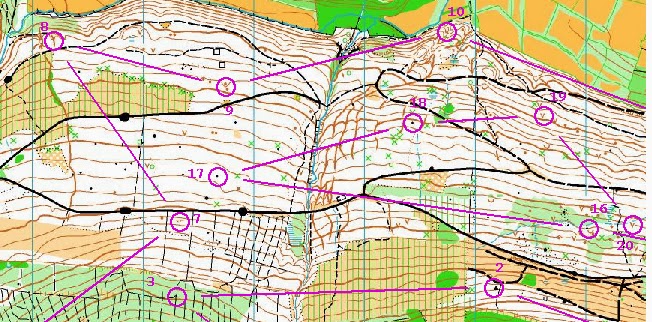
The Sunday event was a classic distance race starting close to the finish of the previous day. No trees today, but lots of boulders. I don’t think I was alone in having difficulty in relating the boulders on the map to the ones on the ground – in the terrain the boulders could be several metres high but these weren’t always clear from the map. The terrain was reasonably runnable and the climb wasn’t too severe.

Monday’s chasing start (where your start time is basically calculated by adding together your times from Day 1 and 2) went off smoothly, with the course leaders starting at 10.00 am. Some fast and furious racing with lots of changes of direction on the longer courses, not too much climb and a nice breeze, brought the runners home happy.

The strain of running an event like this, in quite technical terrain and with such a small number on the organising team, did begin to show this year: there were some issues about the accuracy of control placement and the overall accuracy of the maps which were negative features of the weekend, but overall the event was a positive experience for the competitors and we did express our gratitude to Frank Ryan and the other members of Western Eagles for staging the event. However, if only 150 people are going to come to an event like this, it does demoralise the organising team. Admittedly, there were several repeat visitors from abroad who come to enjoy the Irish orienteering experience again and again, and they were as usual very positive about the event. This year it also clashed with the British Championships, reducing numbers further. SSome additional promotion and marketing of the 3-Day, whether it’s in Connacht or Munster, might bring the numbers up to a level where the event would be financially viable and it would be possible then to do some professional remapping or correcting of the maps to make them above reproach.

See photos of the event here. For results of the individual days see the IOA results pages here.

In previous years the 3-Day Shamrock O-Ringen, spearheaded by Cork Orienteers, has run in the years between the WEGO events, but I understand that no firm decision has yet been taken about the Shamrock next year. It's a lot of work for the organising club, but a lot of fun for the competitors ...

WOC Team Selected
While we were running around Co. Galway, the aspirants for the Irish World Championships team were at the selection races in Italy. You can see the team selections below - congratulations to you all!
The WOC is in early July, largely in the alpine forests in the mountains about 2 hours north of Venice, but with a sprint race in Venice itself. The 5-Days of Italy is being run in parallel with WOC and has attracted an entry of about 1800. See the WOC web site here.


WOMEN MEN
SPRINT Niamh O’Boyle
Rosalind Hussey
Olivia Baxter
Reserve – Susan Lambe
Nick Simonin
Darren Burke
Josh O’Sullivan-Hourihan
Reserve – Colm Moran
SPRINT RELAY Best two results from individual
Competition.
Res – Third athlete
Best two results from individual competition.
Res – Third athlete
MIDDLE Niamh O’Boyle
Res – Susan Lambe
Conor Short
Res – Darren Burke
LONG
Nick Simonin
Res – Colm Moran
RELAY
Nick Simonin
Conor Short
Darren Burke
Res – Colm Moran
Some interesting analysis on World of O into the bunching in the middle distance and classic races in the pre-WOC Italy when the start interval was reduced from 2 minutes to 1.5 in the middle and from 3 minutes to 2 in the long. This is an International O-Federation initiative to reduce the total length of time the competitions take. Read about it here.

Tollymore O-Festival
Another action-packed weekend of orienteering is being offered by LVO in Co. Down on June 20-22nd, starting with an urban race in Newcastle on Friday evening, then a colour event incorporating the LVO Club Championships at Donard Forest on Saturday, then Pre-O (a.k.a. trail orienteering) and junior training that afternoon, plus the NIOA AGM and a barbecue, all on Saturday. On Sunday there's a sprint relay at Tollymore.
Camping is available in the beautiful Tollymore Forest Park, in a special field for orienteers, from Thursday, and there's an NWOC evening event at Drum Manor, Cookstown (admittedly, not at all close to Tollymore) on Thursday evening. More details here. Enter at Fabian 4 here.

Ones to watch
The 17th Setanta Rogaine is on June 28th/29th, starting at the Shay Elliot memorial between Laragh and Glenmalure. There's a 24-hour event starting at 2 pm on Saturday and a 6-hour event starting at 8 am on Sunday; both finish at 2 pm on Sunday. Details here.

Summer evening events in Leinster will continue on Tuesday evenings right through to mid/late August, the first fruit of the revitalised Leinster O-Council. See full details on the IOA Fixture list. After then CNOC series, there will be events run by GEN, Fingal, Ajax and 3ROC, at least. The Cork Orienteers Tuesday evening events continue until July 22nd, while the LVO WEE ("Wednesday Evening Events") run until 27th August.


Lots of Lupins in Finland ...

Take a break from the World Cup on Saturday 14th June and watch the Jukola overnight relay live on the internet. Starting at 9 pm Irish time, the 16000 runners on 7-person teams will run through the night at Kuopio on Europe's biggest inland island. Follow the action here. (In all honesty, it does get pretty damn dull after a while, but the mass start is great and you can drop in and out from time to time!)


HI Time again -  the Home Internationals are calling once more, starting with the Juniors (M&W 14/16/18) at Oban in Scotland on August 30/31, just when you were all safely back at school. See details here. The Veterans (M&W 40-65) are in Wales, in the Forest of Dean, on 13th/14th September. Details here and here. The Senior event (M&W20/21) is in Scotland on October 18/19 in Deeside as part of the "Race the Castles" series - details here and here. It's very unusual to have two HI's in the same country in the same year.

JK Report: falling into the "better late than never" category, I did a report on JK 2014 at Easter in south Wales but it has vanished into cyberspace so I'll have to do it again when I have time ... unless someone out there will do it for me?

Wednesday, 7 May 2014

A Challenging Championships!


Last weekend's Irish Championships provided a range of orienteering types and of running conditions to test the competitors in every aspect of their orienteering, from a fast and furious urban sprint race at the Maynooth university campus on Friday, through mist and heather at the Middle Distance on Saturday, to energy-sapping peat hags and 5-metre visibility on Sunday and even a bit of forest and some steep hills to finish us off on Monday.
Setanta Orienteers and Great Eastern Navigators came together to run the event, with GEN running the sprint on a lovely new map by Jonathan Quinn, and Setanta running the remaining three races near the Wicklow Gap.
The sprint at Maynooth, where the Elite race was won by 3ROC's Colm Moran by 2 seconds from favourite Darren Burke, had perfectly judged winning times of close to 12 minutes, with Colm finishing in 11.59 and Elite Ladies winner (no surprises here!) Niamh O'Boyle in 12.27. In a sprint, every second counts, and classes were won and lost by the smallest of margins.
The courses were confined to the northern part of the campus, with many small and oddly-shaped buildings, some grass and trees, and the runners enjoyed the courses, proving that it is possible to have satisfying orienteering without getting all wet and muddy! See the results, courses and routes here.

Saturday's middle-distance event at Camaderry was another matter altogether, though. Luckily, the organisers were able to get access to the top of Turlough Hill, the ESB pumped storage electricity station near the Wicklow Gap, for parking, avoiding the long slog up the service road, familiar to runners on leg three of the Lug Relay. As we drove up the hill, the mist thickened more and more, until at the top the visibility was maybe 10 to 20 metres: what would it be like out on the course? Would foul-weather gear be required? A cold wind was blowing but it failed to dislodge the mist. The start, finish and car park were at the high point - about 650 metres above sea level, one of the highest drivable points in Wicklow (the summit of Kippure with its TV mast is a bit higher) but after the first control we dropped into the top of the Glenealo Valley on the side of Camaderry and the mist disappeared but the heather got higher.
A run around the sides of the mountain followed by a steep climb back to the finish in the thick mist completed the outing, and GEN's David Healy, back from Sweden for the event, took first place in the men's race with Niamh O'Boyle (CNOC) adding another win to her impressive collection. See the results, courses and routes here.

There is no doubt that the Classic race on Sunday was an epic and was the talking point of the weekend: the cloud level dropped even lower than on Saturday and visibility was down to about 5 metres. Competitors were getting lost in the car park, that's if they could even find the car park. The thought of running 12.7 km with 530 metres climb and 30 controls was a daunting one for the elites, but equally daunting was the prospect of 1.5 km for M85's. (One of the M85's this weekend was Seán Rothery, who I vividly remember running in the first Irish Relay Championships at Ballinahinch in Co. Wicklow in 1975, an event I came across more or less by accident: this old man (why, he must have been at least forty!) steaming down the run-in with a gut-busting finish. How many sports are there that you can compete like that over a lifetime?)

The main feature of the map was the turf banks, an intricate maze of cuttings, knolls and gullies: in practically zero visibility, once you came unstuck, you stayed unstuck! Relocation was a matter of luck or of searching for some distinctive feature and trying again. There was a very high number of non-finishers and the range of times among those who persisted tells its own story. Perhaps the most extraordinary result, though, was the mere three seconds separating winner Marcus Pinker from runner up Colm Moran in the M21 Elite category, after more than  two hours of running in thick mist. In the W21E class, Maeve O'Grady (DFO) took her second Irish title, adding to her win at Inch in 2012.
Looking at some of the routes drawn on Routegadget is fascinating: the little spirals close to the controls as runners searched blindly and found the flag; the larger diversions where they went further astray in the mist in between controls, but few are a spectacular as Colm Hill's excursion recorded by his GPS after control 3  on the Elite course, and very brave of Colm to make it so public! See his route below.
In all honesty, it was among the most challenging orienteering I have experienced: the only thing I found more difficult was the terrain used for the World Championships in France in 2011. In my own case, I threw in the towel several times only to suddenly find where I was and decide to continue a bit longer, a tactic which eventually saw me to the finish line. For me, fogged up glasses and thick mist meant it was pretty much "compass and pacing" the whole way round. I have to say that I thought the area was excellent, the map very accurate (though I still have to find that "indistinct path") and it was much more runnable than I expected, the going underfoot a bit like Inishbofin, with low heather, grass and peat, undulating rather than steep: definitely worth a return trip on a nice dry, sunny day!

Interestingly, Turlough Hill, where there is an artificial lake on the hill top and a natural lake, Lough Nahanagan, at the base, only got this name when the ESB built the power station in the late 1960's: before that it was called Tomaneena. A "turlough" is a disappearing lake such as is found in the Burren in Co. Clare, where the lake comes and goes depending on the water level. This wasn't the only disappearing lake on Sunday, however: Lough Firrib (after which the map was named) proved equally elusive: several competitors decided to use it as an attack point or as a feature to relocate on, but couldn't find the lake! (It was notoriously difficult to find using the old OS maps too).
A water station for the Elites provided a welcome recognisable feature, particularly for one runner who was offered a cup of tea there, which he gratefully accepted! Finishing on Sunday was a real achievement, so very well done all of you.
The organisers wisely recognised the limitations of the area for planning Junior courses, and ran the courses for the youngest kids at Oakwood, a lower down, simpler area of forest a couple of kilometres further west. See the results, courses and routes here.

Monday's Relays at Glenreemore also moved to the Oakwood area and threw in some boulder-strewn forest and steep mountainside. Apart from the mossy boulders and the steepness, the area was runnable and a complete contrast to the previous three days. CNOC took the Open and Women's titles, showing that orienteering is indeed a family sport (Men: brothers Conor and Ruairi Short, Kevin O'Boyle; women sisters Niamh and Caoimhe O'Boyle, Regina Kelly), while Fermanagh Orienteers (Ros Hussey with sisters Eibhlin and Ciara Largey) rose to the occasion and taking their first major team prize, finishing second in the Women's race, 20 years after that club ran the Irish Championships at the Burren on the Cavan/Fermanagh border. LVO finished a close 3rd, only 5 seconds adrift of FermO, while CorkO finished second in the Men's race with 3ROC 3rd .See the results, courses and routes here.

John Shiels of Action Photography took a large number of superb photographs which you can see and buy on his website here.

(This issue of The Irish Orienteer will develop over the next couple of days when I have time, with reports on the JK at Easter and other stuff, so keep coming back! - JMcC)


Tuesday, 8 April 2014

Full Steam Ahead

The high point of the year, the Irish Championships, is approaching and promises to be a great weekend’s orienteering, with a major contrast between the intricacy of the Maynooth University campus for the Sprint on Friday, to the open mountainside, peat hags, moraines and glacial deposits of the following three days around Turlough Hill and the Wicklow Gap. Before that, though, we’re in high gear for the Leinster Championships, the European Championships and the JK at Easter.

The Leinsters saw a respectable turnout coming to the midlands for CNOC’s event on April 6th, travelling from all four provinces. Carrigmeal forest, spread over several distinct limestone hills near Portlaoise, is a largely runnable deciduous forest with crags and quarries, along the lines of Mullaghmeen in Co. Westmeath. Like Mullaghmeen, the forest has some interesting history: Mullaghmeen is the largest planted beech forest in the country, while the forest at Carrigmeal was planted as part of the Marshall Plan to get Europe back on its feet economically, in the years after the Second World War, according to the farmer whose field we used for parking.

Leinster Champions Colm Moran (3ROC) and Maeve O’Grady (CNOC) weren’t concerned with the history but with the present: Colm finished more than 2 minutes clear of second-placed Corkman-turned-Kerryman Darren Burke, with the Short Brothers, Ruairi and Conor, next. (No sign of Harland, however). On the Women’s course, Welsh visitor Katie Reynolds finished fastest on the day but wasn’t eligible to take the Leinster title.

The early heavy showers passed, affecting only the first starters and the unfortunate officials, but a mild, dry day followed for most of the runners. A JK-style parking field, tea and cakes provided by the Junior Squad, and a convivial assembly area made for a great atmosphere on the day.

The area is presided over by the majestic Rock of Dunamase, first settled in the 9th century, whose image featured on the prizes, but for many the steep and muddy hills of Carrigmeal had provided enough running up and down for the day. Maybe next time …

Results and Routegadget are here.

Up the Walls in Derry
Start of the Derry sprint


The city of Derry, Derry/Londonderry, or Stroke City provided a great weekend’s sport around  St Patrick’s Day. Masterminded by NWOC’s Allan Bogle, the "Legenderry" weekend featured a largely-downhill middle distance race at Binevenagh, under the dramatic cliffs overlooking Lough Foyle on Saturday afternoon, then an Irish victory over France in Rugby that evening, followed by three sprint races on Sunday and a further sprint on Monday.

Binevenagh has been used for Irish Championships and Home Internationals but this event mostly used a south-eastwards extension, avoiding the cliffs but bringing us into some dark coniferous forest where optically-challenged orienteers were advised to bring a torch to read their maps! Darren Burke took first place on the Men's course, with Eoin McCullough second; Niamh O'Boyle won the Women's race with her up and coming younger sister, Caoimhe, second.

The Peace Bridge
Sunday's first sprint race started just outside Derry's walls, with competitors walking across the Foyle on the sinuous Peace Bridge to start close to the Guildhall. Start times were early, to avoid tourists and a food fair in the city, and Philip Baxter's courses brought everyone up and down through the walls and around the hilly city. We should have anticipated some deviousness on the planner's part, but the most talked-about leg was one which brought us from on top of the walls, back outside to a cave-like control and back inside the city again. The walls are the most unique feature of the city and it was inevitable that they would be a major factor in the race. A super event, on Allan Bogle's map, and well worth the journey. Eoin McCullough outsprinted the field to finish 7 seconds ahead of Darren Burke, reversing Saturday's result, with Niamh O'Boyle taking the Women's race from second-placed Ros Hussey.

Post-mortem time
Back across the bridge then to the second sprint, in St Columb's Park and the newly renovated Ebrington Square, a former military barracks (in use since the siege of Derry in 1689) now being swords-into-ploughshared to a public space. More St Patrick's Day festivity here, but the orienteers sprinted around the Park and the Square first. Not the same degree of challenge as the walled city, but a chance to run hard and finish on a running track, while keeping something in reserve for the third sprint of the day, at Coleraine in the afternoon. Darren again finished first with Josh O'Sullivan Hourihan second and Eoin third; winner Niamh again kept Ros and third-placed Olivia Baxter at bay on the Women's course.

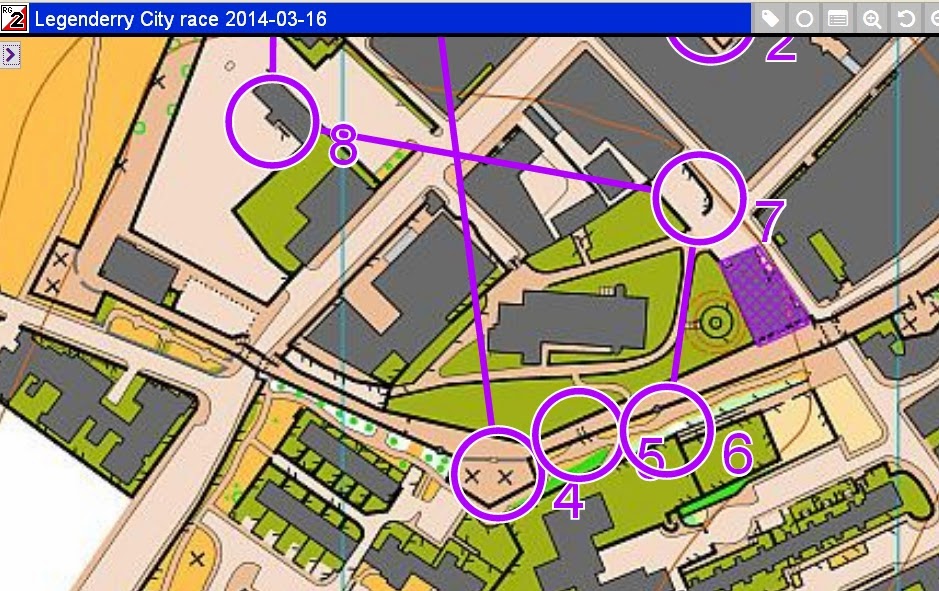
How would you do 4-5-6?
The lure of the food fair proved too strong, so back over the bridge again to feast on goat burgers (I kid you not).


Control 4-5-6 ... so near and yet so far!
The 1960's University of Ulster campus, outside Coleraine, was the venue for this last event of the day and of the Campus Sprint series, a fundraiser for the Irish Juniors to help their travel and training plans. Susan Lambe planned and a good turnout of seniors and juniors ran. The area had been used for an Irish Sprint Championships in 2010, so we had an idea what to expect. We didn't revisit the underground control that was used at IOC, but it was a good gallop to finish off the day. Josh had his moment of glory here, finishing ahead of Kevin O'Boyle and Darren; while Kevin's sister Niamh was again the fastest lady, Caoimhe second and Róisín Long third.
You can find all the results from the weekend here.

St Patrick's Day itself saw the final event of the weekend, an ultrasprint style event again in St Columb's Park, featuring a shamrock-shaped specially constructed maze which runners entered at different stages in their courses. Unfortunately I wasn't able to stay for that and I
Prizewinners at Coleraine
haven't heard any reports except that it was great fun, though quite labour-intensive as the planner, Stephen Gilmore, had to construct the maze himself using a large number of stakes. Darren Burke was the fastest on the Shamrock Sprint, fittingly, as his club, Cork Orienteers, were the initiators of the Shamrock O-Ringen, the three-day event which started on St Patrick's weekend in 1989, later moving to the warmer weather of June.

Curiously, at the other end of the country, another St Patrick's Day event, at the opposite end of the distance scale, was taking place. Bishopstown Orienteers from Cork were running a long distance orienteering course and navigation challenge in the Galtees, to mark their 20th anniversary. The event was based on an idea from Poland, an extreme orienteering event at Gezno, and was promoted by one of their members from Poland. Just up the road at Glengarra, Cork Orienteers were running a Munster League event on Sunday 16th. A busy weekend, all in all.

What's coming up? 
Well, a small group of orienteers are heading this week to the European Championships at Palmela in Portugal, while Trail-O specialists from LVO Wilbert Hollinger, Declan McGrellis and Stephen Gilmore are representing Ireland at the European Trail-O Championships there before returning home via JK2014 in South Wales at Easter.

The JK has topped 3000 runners this year, lured by the hope of reasonable weather with a late Easter, and the complex limestone moorland in the Brecon Beacons National Park which hosts three of the four races. The fourth event, the Sprint on Good Friday, is at Swansea University. Entry has closed but you can follow the fortunes of the runners here.

Two weeks after the JK we have the Irish Championships, this year featuring four races, starting with a sprint (12-15 minute winning time) on a new map of a new area, the University campus at Maynooth, mapped by Jonathan and Laurence Quinn. Start times are from around 6 pm. Planner Laurence has a lot of experience of sprint maps and courses and the event promises to be a cracker.

Saturday's Middle Distance race, run by Setanta, is at Camaderry, just west of Glendalough, and Sunday's Classic distance race just a little further west again, around Lough Firrib (that difficult-to-find little pond on the Lug Walk). Monday's Relays are on the west side of the Wicklow Gap, at Glenreemore. You can get a flavour for some of the terrain of nearby areas on Routegadget: Fair Mountain; Glashaboy Brook. See all the IOC details here.

O-Bits
The formality of an LOC meeting ...
Leinster Lives! Representatives of the Leinster clubs met at the Leinster Championships to bring the dormant Leinster Orienteering Council back to life. Putting together a full fixtures list for the next year was number one on the agenda, with discussion also on the IOA plans for provincial development officers, training schemes for juniors and novice orienteers, and how to attract people to the sport. The 2014-15 League will be a single league rather than two halves; the league events will alternate with local non-league/"come-and-try-it" events, there are plans for a mountain bike O-league, and the two student clubs will each run a League event ... all very positive developments.
Brockagh Spectre: a difficult decision will have to be faced on May 11th, whether to take in the final Leinster League event at Brockagh, near Glendalough, or go to see the Giro d'Italia bike race on its way from Armagh to Dublin. It's due in Dublin at 4 pm so an early start at Brockagh should do it ...

From the archives
20 years ago: in Spring 1994, the list of Irish O-clubs included Athlone RTC Orienteers, Eastern Command Orienteers, Former UCCO, Kevin Street Orienteers, Lee Orienteers, Phoenix Navigators, Southern Orienteers, Thomond Orienteers, UCG Orienteers ...where are they now? ... Ultrasport were selling VJ O-shoes for £33.99 and £39.99 (O-shoes must be proportionately cheaper now?) ... Casio 30-memory stopwatches were all the rage in the times before SportIdent. A new one was soon to go on the market at about £75 ... Munster runners were being encouraged to travel to Galway for the Interprovincial Championships in March, which they had won for the past two years ... Pat Healy was preparing the map and courses for the second Lowe Alpine Mountain Challenge in the Comeraghs in May ... John Lyons (UCDO), Deirdre Ryan (GRTCO) and John Feehan (UCCO) were elected officers of the Irish Orienteering Students Association ... LVO and 3ROC announced a joint two-day event at Slieve Martin and Carlingford, spanning Carlingford Lough, and a Welsh team was expected to travel for the "Celtic Cup" Ireland v Wales challenge. Entries were £6 per day for seniors ... "Walking World" magazine was launched by the publishers of "Irish Runner" ... there would be a Lakeland 5-Day in August 1994, just as there will be in early August this year ... a standard entry form for pre-entry events was being introduced ... GEN ran the Leinster Championships at Glencree in March ... WATO were to run the Munster Championships at Mahon Falls in April and the Irish Championships would be at the Burren on the Cavan/Fermanagh border in May ... 31 people finished at the 3ROC night-O in Dublin's Phoenix Park in February ... Annual membership of clubs cost about £8 for adults ... 3ROC ran "Not the JK" on Easter Monday, but the TIO report misprinted it as "Waster Monday" ... The Irish Orienteer Trophy inter-club competition was still going strong, with WATO, CorkO, BVOC and LeeO battling it out in Munster; LVO taking on FermO and NWOC in the North; 3ROC v GEN v AJAX and SET v FIN v CNOC in Leinster. The National Final would be in September and the winners were expected to represent Ireland at the CompassSport Cup in Scotland in October ... Justin May had just won 4 Trailquest MTBO events out of 4 in the series in the UK ... The Irish Junior Panel consisted of more than 120 orienteers including such household names as M13's Allan Bogle and Ger Butler, W13's Aislinn Austin and Susan Bell, W15 Toni O'Donovan, M15 Shane Lynch, M19 Marcus Pinker and M17 Shane O'Neill (who has just won M35 at the Leinster Champs ... the 3-Day Shamrock O-Ringen moved to Inchigeela in July ...

Friday, 28 February 2014

Spring is Sprung ...

Night OrienteeringNight, Night, Night-O
The night orienteering season is over for another year. A busy schedule of "Dublin by Night" events taking in old and new areas, and easy and difficult ones, ran from early December to mid-February, providing a fuller fixtures list than the normal day-orienteering one in Leinster. A cancellation of the Kerry Orienteers event in Killarney took one night-O out of the equation. The Northern Ireland Night Championships was on last weekend and soon the clocks will go forward, depriving us of those precious hours of darkness beloved of night orienteers.
I enjoy night orienteering: keeping track of where you are is more difficult and more important than in the daytime as mistakes are easier to make and more costly to correct at night. Some other orienteers obviously agree, but not too many: the turnout for most of the DBN events was in the 40's. Is night-O too specialised? Too challenging?  Too difficult to get to? At the wrong time of year?
The numbers attending orienteering events can be very disappointing: Fingal's Spring Cup event last Sunday at Rossmore, Co. Monaghan, attracted only 60 runners. An obvious difficulty here is that there is no nucleus of orienteers in the area to bring the numbers up, but it must be demotivating for clubs, particularly for the mappers, planners, organisers and controllers who make the events happen, if their efforts go unrewarded.
It's not about money (or not just about money): we all like to feel appreciated, but we'd all like the clubs and the sport to be financially viable. Bigger numbers at events mean more money for the clubs and for the sport. With that money the clubs can pay for mapping, they can subsidise juniors to go abroad to events and to training, they can invest in the sport. Without that income we are on a downslope, with falling participation, fewer people seeing the need to join clubs to ensure the future of the sport and an increasingly older age profile in the clubs.
Are there too many clubs? Do we need to bring the orienteering to the people and not the people to the orienteering? Is it time to reinvent the sport, taking it away from the woolly-hat in the forest image to make it an exciting sprint in a park?
Look at mountain running: the recent race on Three Rock attracted about 300 runners. Look at the Park Runs which regularly attract hundreds of runners. Look at the mountain-bike races on some of our orienteering areas, attracting good numbers at many times the cost of an orienteering entry.
Buy a mountain bike and the same day you're experiencing the thrills and adrenalin of charging downhill through fantastic forests and trails in natural surroundings. Take up orienteering and experience what, exactly? The frustration of getting lost? The slow learning of map features, compass work and pacing? People nowadays want instant gratification and that's not something which orienteering in its present form can provide. Maybe it's not something we should aim to provide, but without capturing and retaining new people, we're going to be in trouble.
Now, where was I? Night-O: if we are to make it attractive to the day-O people, we need to make it  less intimidating: perhaps a mix of parks and urban areas, university campuses and easy forests, graduating to more difficult areas of forest of sand dunes, but a progression. We exclude under 16's for insurance reasons; to a large extent we exclude people who don't have a decent headlight (though the price has fallen and the quality has risen dramatically in the past few years); we exclude people who rely on public transport. We need to be an inclusive sport, not an exclusive one.

Springtime
Anyway, as spring has sprung, we have the various spring series of competitions in full swing, as well as the great Campus Sprint events which raise money for the Juniors. After a confusing start this year, the sprints at Waterford IT, DCU and UCC are culminating in the TCD and NUU (Coleraine) events on March 1st and 16th.

The LegenDerry weekend of March 15-16-17 has a great range of competitions, from the walled city of Derry, to St Columb's Park in that city, a middle distance race at Binevenagh near Limavady, a sprint at NUU Coleraine and an ultrasprint back in St Columb's Park again. Details and entries are here.

The Rock of Dunamase
Looking further ahead, the Leinster Championships on April 6th are being staged by CNOC at Dysert, close to the Rock of Dunamase in Co. Laois (definitely worth a visit: read about Dunamase here and see details of the event here.). Entries close on March 26th. See the map from the previous (April 2012) event here.
Just two weeks later, the Jan Kjellstrom O-Festival is in south Wales at Easter. Details of the sprint at Swansea University and the other events in the Brecon Beacons are here.

Another two weeks (May 2-5) and we'll have the Irish Championships in Co. Wicklow, with the Sprint Championships at the university campus in Maynooth, Co. Kildare. Details are here. Cheaper entry fees apply until 31st March.

Poetry warning: Stop here if you don't want a blast of whimsical poetry which has nothing whatsoever to do with orienteering ...

Spring

NOTHING is so beautiful as spring—
  When weeds, in wheels, shoot long and lovely and lush;
  Thrush’s eggs look little low heavens, and thrush
Through the echoing timber does so rinse and wring
The ear, it strikes like lightnings to hear him sing;      
  The glassy peartree leaves and blooms, they brush
  The descending blue; that blue is all in a rush
With richness; the racing lambs too have fair their fling.
What is all this juice and all this joy?
  A strain of the earth’s sweet being in the beginning    
In Eden garden.—Have, get, before it cloy,
  Before it cloud, Christ, lord, and sour with sinning,
Innocent mind and Mayday in girl and boy,
  Most, O maid’s child, thy choice and worthy the winning.


(Gerard Manley Hopkins)

(At least it's a nice change from Winter, when Dick the Shepherd blows his nail and milk comes frozen home in pail, and so on!).


Sunday, 19 January 2014

Another year ...

A belated "Happy New Year" to all our readers. There's lots of exciting orienteering in prospect for 2014, with new areas both at home and abroad; night-O, Sprint-O, a World Championships, and accessible multi-day events in Wales and the English Lake District. The Juniors have some interesting plans too, with the prospect of training in Norway for next year's Junior World Championships as well as a trip to the JK at Easter in Wales and maybe to the Lakes 5-Day in August.

A brief look back ...
One of the series of events this year is the Campus Sprint races to raise money for the Junior Teams. Two events have already been held, at Waterford Institute of Technology in October and at Dublin City University in December.
The DCU event offered entrants a choice of a map in English or Irish, and planner Kieran Rocks used a seasonal Christmas tree as a control site, while one of the other sites, a statue, looked like something from Easter Island! (The juxtaposition of these festivals reminds me of the quiz question "When did Good Friday fall on Easter Monday?" - the answer is at the bottom of the page.) Further events in this rather scattered series are rumoured to be in UCC on February 15th with further events in TCD on 1st March and others at unspecified future dates...

... and forward
As usual at this time of year, TIO reviews some of the interesting events both at home and away, for the coming twelve months. Ireland, Portugal, Italy, Finland, Sweden, the UK and Brazil all feature. Even if you can't go to any of these events, you can get lots of fun from looking at the websites!

Spain and Portugal are attractive destinations in the early part of the year, and this year sees multi-day events in Andalucia (February 14-16) with a World Ranking Event (WRE) at Punta Umbria, near Huelva, with training during the following week - not far from Faro airport (see here) , and the Mediterranean O-Championships in Portugal on 21st-23rd February, again with WRE's, 160 km east of Porto, with a middle, sprint and long distance race (and some Irish already travelling) - see here. Who cares if it's not really on the Mediterranean if the entry fee is only about €20 for three days? The same weekend, there's an interesting concept at the Kvarner Bay Challenge on Cres Island in Croatia, where the entry fee is whatever you decide it's worth - see here. Moving north, the Swedes come out of hibernation on February 28th with the Pan-Spring at Kristianstad with night, middle and long races close to where the 2014 O-Ringen will be - see here for entry details.
Early March has the Portugal O-Meet at Gouveia, in the middle of the country, from March 1-4. This has two middle and two long races, a night sprint, and trail-O, plus training opportunities. A week later you could run on the karst limestone terrain of Slovenia at the Lipica Open. If you're taking off for St Patrick's weekend you could go to the Mediterranean Open Champs in Tuscany on March 13-15. The event has a sprint, a middle, and a sprint in Florence. There's also a pre-World Championships training camp near Venice from March 9-13. If you want to stay at home that weekend, there's a sprint race in the walled city of Derry on the 15th, with a middle distance race the next day in the same general area adding up to 5 races in three days. There are also hints of a long-O type event in the Galtee Mountains on March 15th/16th where Bishopstown Orienteers are celebrating their 25th birthday (details here), where there's also a CorkO Munster League event in the same area. Back in Scandinavia, the Danish Spring event, marking the end of winter, is on March 22-23 in North Zealand, north of Copenhagen, with sprint, middle and long races but no relay.
Moving into April, CNOC's Leinster Championships at Dysert, near the Rock of Dunamase in Co. Laois, is on the 6th. Further afield, there's a World Cup race at Murcia in southern Spain on April 4-6, followed by the European Championships at Palmela, just outside Lisbon, in Portugal from 9th-16th, that's roughly the week before Easter. Between then and Easter, the Riga O-Week in Latvia takes place (15-21st) in the 2014 European City of Culture, and the Spanish Championships in Andalucia (17-21st) where the Malaga orienteering club are also celebrating 25 years. At Easter, the Jan Kjellstrom O-Festival is in south Wales while there are also multi-day events in Prague (18-20), Sardinia (18-21) and Bulgaria (18-21).

The Irish Championships in Kildare and Wicklow kick off the month of May: a sprint on a new map of Maynooth, and middle, long and relay races near the Wicklow Gap. The same weekend, the big overnight relay "Tio Mila" is on in Sweden. 2014 is a big year for orienteering in Italy: at the end of May, there's orienteering in Trentino, in the mountains north of Venice, the "3 days of Trenches", to commemorate the area where there was fighting in the First World War 100 years ago. This is followed by the regular "Highlands Open" WRE on June 1st.

Apart from Western Eagles Three-Day in Co. Galway on May 31-June 2 and the British Championships near Newcastle on 31st/1st, , there's also a 3-day in Belgium at St Hubert (June 7-9th) and the 11th European Rogaining Championships in Estonia (7-8th). Moving towards the main orienteering holiday season, the 66th Jukola 7-person overnight relay in central Finland is on June 14-15, with the Venla women's relay in the afternoon of the 14th: thoroughly recommended. This is followed immediately by the Tallinn O-week in Estonia. For anyone searching for something a bit more exotic, there's a 3-day in Iceland on June 27-29 and there are also a competition in Greenland (July 2-5). (A new airline called Wow Air flies from Gatwick to Iceland). Back in Sweden, at Salen (location of the 2008 O-Ringen where the Irish Juniors went on tour) there are 3 days competition on June 27-29, and three evening races in Stockholm on June 30-July 2, allowing you to be a tourist in the daytime and an orienteer in the evening.

Peak multi-day event time starts in July with the Sorlandsgaloppen (July 3-6) in southern Norway, but a big attraction will be the World Championships in Asiago in  northern Italy (July 5-13) with the associated Italian 5-Day open to everyone and including a sprint race in Venice. Clashing with this is the Fin-5 five day in (you guessed it!) Finland, at Kuusamo, from 6th-10th. Rather more out of the way is the Romanian "Transylvanian Open" at Cluj (July 10-13) leading towards the Junior World Championships at Borovets in Bulgaria from July 21-17. (Cluj is the venue for the 2015 European Youth O-Champs - the 2014 EYOC is in Macedonia on June 25-28). A longer event is the Kapaonik Open in Serbia (July 10-20). In Switzerland the Swiss O-week returns to the spectacular setting of Zermatt at the foot of the Matterhorn from July 19-26 and overlaps with the 50th Swedish 5-Day O-Ringen in Skane from July 20-16. The world's biggest orienteering event promises lots of seaside forests in sunny southern Sweden - the O-Ringen is a must at some stage in your orienteering career!
Croatia, Slovenia, Norway and Slovakia also have multi-day events in July, and the World University Championships are at Olomuoc in the Czech Republic, location of WOC 2008, from August 11-17.

In August the closest multi-day event to us this year is the Lakes 5 Day in the English Lake District (August 4-8), promising varied terrain and lots of international competitors, but lake district traffic and accommodation are issues you may also have to contend with. In August, Slovenia hosts the OO Cup (1-5th) on what looks like spectacular Alpine terrain, and there's a 5-day in Spain, 240 km north of Madrid on August 5-10 and a 5-Day at Uslar in Germany (4th-9th). The World Rogaining Championships are in South Dakota, USA, on August 16-17: "Rogaining" is long distance orienteering where you visit as many controls as you can, like a score event, but over a 24 hour period. Back in Hungary, the Hungaria Cup runs from 16th-20th near Budapest, then Greenland beckons again (August 23-25). For army orienteers, the CISM Military World Championships are in Austria from 24th August.

By September the big multi-day and holiday events are over,but there's still plenty of good orienteering on, notably a series of four city races in London, Barcelona, Edinburgh and Porto. The London race, on Sunday September 21st, has an urban race in Guildford the day before; the Porto race in Portugal on October 3-5 has a night event, relay, score and city races. Edinburgh (11-12 October) features city races at Edinburgh and Stirling Castles, and Barcelona (1-2 November) with a sprint in Nou Barris Park and an urban race around the Old Town, complete the City Race Euro Tour.

Meanwhile, back in Italy, Croatia and Montenegro there's 10 days of orienteering from Sept 29 to October 10: what a way to end the summer! Moving on, how about the 11th Istanbul 5-Days (October 29-November 2) which sometimes features a night race in the Grand Bazaar. For the more ambitious, the World Masters O-Championships (for over 35's) are in Brazil has sprint, middle and long races from November 1-8.

At the end of the year, you have a choice of the warm or the cold ... the Sylvester 5-Day in Belgium (December 26-30) or five events in the Canaries (Dec 27-Jan 4 2015).  Then, to look forward to in 2015 we have the World Championships coming to Scotland in August with the Scottish 6-Day, hopefully a Shamrock O-Ringen in West Cork in June, and the Swedish O-Ringen and the World Masters back to back in SW Sweden.

Fore more details of these events,and of many more, visit the World of O web site. Thanks to CompassSport Magazine, the IOA web site www.orienteering.org and World of O for the information I have extracted and presented here.

Finally, here's an interesting street map for you: do you recognise it? Look closely to read the street names.
During the Cold War, apparently the Russians mapped cities and towns all over Europe and Dublin was no exception. This 1970 map shows (obsolete) tramlines and the uncrossable river Liffey and the text is in Cyrillic script, incidentally named after Saint Cyril. See more here.

Good Friday question: Reportedly a horse called "Good Friday" fell in a race on Easter Monday in 1946.

That's all for now.


Thursday, 5 December 2013

December 2013/1

Sprint for the Juniors
The second of the Campus Sprint events in support of the Junior Squad is on Saturday December 7th at Albert College and DCU in Glasnevin, Dublin. Kieran Rocks has planned two courses of about 2.2 and 2.9 km (straight line distances) starting and finishing in the park but mostly on the Dublin City University campus. Start times from 11 to 1 pm at Hampstead Avenue off Ballymun Road.
There will also be sprint events in Cork, Belfast and Limerick, with the proceeds going to the irish Junior Team. See more details here. You can register online here, or just turn up on the day.
Come and sprint for the Juniors!
(You can read about some Junior activity here, where Robert Pim, Zach O'Sullivan-Hourihan and Caoimhe O'Boyle went training with the top British juniors in the Lake District recently).

Night-O starts
The weekend of December 7th/8th is a busy one for orienteering, with the first of the Dublin by Night events on Saturday at Carrickgolligan, between Kilternan and Shankill, Co. Dublin. Two courses,start times from 6 to 7 pm. See details from the organisers, GEN, here.
For night-O fans, there will be more night events at Phoenix Park (January 4th), Glendoo (January 11th), Massy's Estate (January 18th), Tolka Valley Park (January 25th), Rockbrook Park School (February 1st) and a CNOC event on February 8th. Kerry Orienteers are also running one at Knockreer, Killarney, on February 15th.

Looking forward, the  Northern Ireland Night Champs are on February 22nd at Loughrey Campus, Cookstown, Co. Tyrone.
There has been some discussion on the IOA Forum about night events: how technical should they be? Would people travel further for more technical challenge or would they prefer easier to get to events that maybe aren't as challenging? What would you like?
So, say goodbye to Saturday Nights!
As an aside, the night event planned by Allan Bogle for 5th December at Loughermore had to be cancelled because of the storms and the exposed terrain.

SouthEast short course & POC at KK
Also on the weekend of 7th/8th December, Waterford Orienteers are launching their new map of Kilkenny Castle with a South east Short Course League event on Sunday 8th.
 
Leinster revives
A groundswell of support for the revival of the dormant Leinster Orienteering Council has resulted in a planned meeting on December 12th after the presentation of the Autumn Series league prizes at BaseCamp in Middle Abbey Street in Dublin. See details on the new IOA Forum here.
Priorities are fixtures co-ordination and more cooperation between the clubs to promote the sport by running series of local events.
Jon Musgrave comes to Hillsborough
Jon Musgrave- one of the UK's top coaches and silver medal winner from WOC 1993 - is coming to Hillsborough on 14-15th Dec to hold a coaching workshop. The weekend is designed to be beneficial to both athletes and coaches.
The Saturday session is aimed at juniors/ beginners and those that are interested in coaching at that level. The Sunday session is for older more regular orienteers and those that would like to coach at that level.
Basically if you orienteer- or would like to start orienteering- then this is the perfect weekend for you!!
NIOA Coaching Officer Allan Bogle needs to know if you are interested in coming. See more details here.
 
O-bits
See the short promotional video for orienteering (and particularly for the Swiss brothers Martin and Daniel Hubmann) "Go hard or go home"  here. The "Route to Christmas" feature is back for another year at World of O. See Day 1 here. Orienteering in south Wales at Easter? Entries to the 2014 Jan Kjellstrom O-Festival in the Brecon Beacons at Easter have opened. See details here. The JK is Britain's biggest competitions, with sprint, two day's individual and a relay over the Easter weekend.

Finally, the sad news that Nuala Rothery, wife of Seán and mother of former Irish Champions Eoin and Colm, died recently after a short illness. Seán, one of the founders of Irish Orienteers and of the IOA, and designer of the original IOA logo, is still orienteering in the M85 class whenever it is provided (well done, Frank Ryan for having the class at the Connacht Championships). Both Eoin and Colm are now based in Australia but are still active in orienteering, Eoin having embraced MTBO as well as the running variety, and is a regular reader of TIO and was a frequent contributor in earlier times, as can be seen from the TIO archives here. Our sympathy goes to Seán, Eoin, Colm and Fionnuala and their families.

Tuesday, 12 November 2013

November 2013

Championships Time
While the Irish Championships come at the effective end of the competition season, at the beginning of May, the Northern Ireland, Connacht and Munster Championships cluster in the autumn. This year the Connacht Championships were brought forward to the end of September only to be moved back to the end of October again following a clash with the Senior Home International, and the Munster Champs were run a week later.
It's unusual these days to get to run in a forest on two successive Sundays, with so many events taking place on open mountain, but both Championships provided good orienteering in good forests. The Connacht Championships, run by Galway's Western Eagles club at Newcastle Demesne near Ballymahon in Co. Longford, offered an interesting mix of coniferous and beautiful runnable beech wood, with an elegant setting in front of Newcastle House, the seat of the King-Harman family since the 1700's, on the banks of the river Inny. Heavy rain early in the day tested the waterproof maps to the limit, while Frank Ryan's courses used the best parts of the wood, though anyone taking the longer road routes got to know one or two sections of road intimately. 3ROC's Colm Moran took the M21Elite course while CNOC's Niamh O'Boyle won the W21 Elite. The event was run largely for the benefit of visiting orienteers as the small number of Connacht runners were mainly involved in helping: there was, however, one Connacht prizewinner in Derek Conerney, 2nd in M40L. Once again, hats off to the small group of orienteers in Connacht who ran the event: in all honesty I have to say it was much better than I had expected! You can see the results, routes and split times here.
The following Sunday, Cork Orienteers ran the Munster Championships in a classic Galtees forest at Toureen Wood near Cahir. Galtees forests tend to have large erosion gullies running down the sides of the mountains and forests roads running parallel to one another across the slope, and Toureen Wood is no exception. Starting high and finishing low may have reduced the climb on the courses but it didn't eliminate it altogether. The turnout was better than for Connacht, with a good representation of Munster and Leinster runners and a handful from Connacht and Ulster, not to mention a couple of Swedish visitors. Cork O's Darren Burke retained the Munster title, his fifth, while his clubmate W18 Niamh Corbett continued to make her mark and took the W21 title. Yet another good day's orienteering in quite detailed forests where, again, the planners (Liam O'Brian and Willie Fitzgerald) made the best use of the area. You can see the results, routes and split times here.

Wherefore Art Thou?
For those unfortunates who weren't able to make the Munster Championships, there was some consolation in the Three Days of Rome the same weekend.  About 20 orienteers from Ireland made the trip, and you can read Niamh O'Boyle's account of the races here:

With the World Championships to be held in Venice in 2014, meaning an embargo over parts of the city, the Italians took the opportunity to offer a 3-day event in Rome instead. It attracted 18 orienteers from Ireland out of a total of 974 from 17 countries. Our group of myself, Kieran Rocks, Susan Lambe, Marcus Pinker and Ger Butler had a great apartment just down the street from the Colosseum. 


 Day 1 was held in a fairly straightforward park, made much more interesting and fun by running the event as a mass start night-O! Villa Borghese is one of the most popular parks in Rome just north of the city centre. Fast and furious, you had to run fast or get left behind. Wilbert Hollinger kept his cool to finish first by 5 seconds in M65. Mary O'Connell of 3ROC took 2nd place in W50 and Aoife McCavana of GEN was 3rd in W18. My map with route from the women's elite course is here.

Day 2 in Villa Ada was a totally different proposition - green and hilly with lots of route choice (through the green or around on paths?). It was hard to follow the little paths in places and many people lost time wandering around, including me on no. 10. Wilbert was 1st again, Mary was 2nd again, and Marcus Pinker took 3rd place in M35. Again, my course/route is here.

Day 3: the main event. This was the one that we had been waiting for; a chance to run around ancient Rome, past the Colosseum, on the same streets that the Emperors once ruled over. The race didn't disappoint and required forward planning and nifty footwork to avoid tourists and garbage trucks in the narrow streets. There was also a challenging crossing of a major road - the option being to throw yourself in front of the cars and hope they stopped on time to save time or politely wait until they had passed. Marcus was the only one in the top 3 today, with a fine 2nd place in M35. Most of the W21 course is here (no A3 scanner - hence no. 1 is missing).
The Irish put up a good show overall with Marcus sneaking up to 2nd on M35, 19 sec ahead of 3rd after 112 mins of running! Wilbert took 1st place on M65 despite dropping time on the third day, and IOA chairperson Mary was consistent enough to finish 2nd. I'm not sure if they will run this event again or if it will revert to Venice, but it's definitely a nice choice for a weekend of orienteering in November (25 degrees and sunny :)

Calling all Controllers
IOA is running a one-day Controllers' Course in Kildare on 16th November, given by the doyen of UK controllers, Graham Nilsson. Graham has given controlling and planning courses here before and they are excellent. However, it is limited to 15 people and by the time most of you see this it will probably be over ... (but look for a dramatic improvement in course and event standards?)

O-Bits ... EYOC Photos taken by Gerry Meehan at October's European Youth O-Championships in Portugal are here ... IOA are running a two-day First Aid course in Newbridge on 30th November/1st December. At present there are only 2 places left. Details here ... There is to be a sprint event at Dublin City University on Saturday 7th December to raise money for the Junior Squad. There were four great sprint events last year for the same purpose, so here's a chance to do some sprint-O training in preparation for the Irish Sprint Championships at Maynooth at the beginning of May ... JK2014: entries are now open for Britain's biggest O-event, at Easter (April 18-21) in South Wales. See here ... Sad news: the death occurred on November 5th of Nuala Rothery, wife of Seán Rothery, one of the founders of Irish orienteering, and mother of former Irish Champions Eoin and Colm.