Thursday, 15 September 2011

What the Dickens?

Sweeney Todd, Jack the Ripper, Charles Dickens - they'd all have felt at home in last weekend's London City orienteering race. The 4th staging of the event saw more than 1100 orienteers from more than 25 countries running in the heart of the city, down alleyways, across squares and cemeteries, through the quiet Saturday streets of the financial centre of one of the world's great cities.
Don't confuse urban orienteering with sprint orienteering: anyone running the 8.9 km Men's Open class will soon realise the difference. Course lengths were measured as the crow flies, which is fine if you're a crow. Typically the actual length was about 50% longer, depending on your route.
Carlow's Gordon Parker, the course planner, used the multi-level Barbican Estate and Arts Centre as the start and finish area, throwing the runners straight into a confusion of levels, tunnels, ramps and passageways which were difficult to represent on a two-dimensional map. The 1:5000 scale map, however, showed the detail clearly and - given a bit of careful map-reading - allowed the runners to figure it out. (In fact there was a significant Irish input into the race, with Ronan and Julie Cleary the Controllers).
The streets of the financial district were surprisingly quiet and but the hazards still included groups of Japanese tourists craning their necks to see St Paul's Cathedral rather than looking out for orienteers.
Although I have run urban races before, they tend to be short, whether in the JK, the Swiss 6-Day or at night in a Portugese fishing village (that was fun!), but this was unlike any orienteering I had done before. Popping in and out of small alleyways; suddenly emerging beside the Gherkin or St Paul's or some other well-known landmark: there was always something new around the next corner.
There are some different issues in urban orienteering: roadworks and building sites are obvious ones. These are marked on the map in pink, but because they can come and go at short notice, the terrain and the map are in a state of flux right up to the race. Have a look at the map and courses on Routegadget here. The event web site is here.
The best known urban race is probably in Venice in November, but the London race may come a close second. Hamlet without the Prince? Venice without the canals? Because London is comparatively close to Ireland, maybe we overlook it as a destination, but the London City O-race is definitely worth a trip. Ask any of the LVO, Fingal or 3ROC runners who went this year.
Next year's London City race is on 22nd September, followed the next day by the Southern Championships.

Super Sprint
Many of the runners who did the London City race stayed on to run an "Orient-Show" style sprint race the next day in Regent's Park. The LOK Ultra Sprint Challenge format was three races of about 1 km which all the runners did. The times of these three races were added together and the fastest 4 runners in each class (Junior Boys, Veteran men etc) were set off together in the final a while later. These would finish 1st, 2nd, 3rd and 4th in the competition. The slower runners then started at 15 or 20 second intervals in groups of four and they would then finish 5th, 6th etc. The courses were gaffled to reduce following (i.e. broken into separate segments which runners took in a different order). It took a lot of work with planning and organisation, not to mention getting all the SportIdent details right, but it provided a fast, fun event for the competitors.
The courses included two sections in man-made mazes, visible to the spectators. The total area was only about 200 m x 300 m and it all fitted on a 1:1000 scale map with 1 metre contours on an A4 page.
The navigation was tricky (there were no control descriptions or control codes except for the juniors) and the precise control locations were shown by a small dot in the centre of the control circle. Some controls were within about 1 metre of each other, so you had to be careful you visited the right one and that you took them in the right sequence.
Mispunching did not mean disqualification, but you got a 30 second time penalty added on to your running time for each wrong control. Given that there were about 25 controls on each 1 km course, that could be a lot of penalties!
Fingal brother and sister Sandis Rektins and Zanda Rektina won the Junior Boys and Junior Girls races.
Here is the map for the final 1.4 km race. (You may notice a small enlarged area in the SE corner of the map, showing the maze at a larger scale. That's the kind of thing you only notice when you look at the map after you get home ...!)

Thursday, 1 September 2011

September 2011 News

World Championships Report
Solid runs from the Irish team at August's World Championships in France weren't enough to qualify for the finals, with the exception of Aislinn Austin in the Middle Distance. Several close calls, where runners just missed the cut, and the misfortune of a mispunch for David Healy, an injured ankle for Nick Simonin and a leg injury for Marcus Pinker, added to the story of WOC2011.
Read the gripping first hand WOC reports from the Irish Team on the team blog here.
The French were formidable, with star Thierry Gueorgiou taking gold medals in the middle, long and relay races. Sweden topped the medals table with 10, France took 4, Switzerland 3, Norway, Finland and Czech Republic 2 each and Denmark 1.
One of the overlooked results at WOC 2011 was Wilbert Hollinger's 8th place in the Trail O WOC, interestingly one place ahead of Italy's Remo Medella who produced the map for the JK Sprint race at Stranmillis College last Easter. Wilbert and his LVO clubmate Alan Gartside were the only two Irish representatives at WTOC. Wilbert was a member of the first Irish team to take part in WOC back in Scotland in 1976. It was announced at WOC that Scotland will again be hosting the World Championships in 2015.
Marcus in the Relay
Other interesting features of WOC were the disqualification of 45 runners in the Sprint Qualification. Some were unfortunate to mispunch on closely-spaced controls but many were seen by officials while crossing out of bounds areas or features marked as uncrossable - so it pays to be careful. Soren Reichers, running for Germany but no stranger to Irish orienteering, was one of the disqualified men. On the other hand Denmark's Emma Klingenberg, again familiar to Irish orienteers, finished 7th in the qualification race and moved up to 6th in the final, only 47 seconds down on the winner, Linnea Gustaffson of Sweden.
Even some of the best orienteers were defeated by the terrain - Finland's Minna Kauppi missed the first control on the women's long final and retired.

What about the terrain? Tales had come back from the training camps of unrelenting technical low visibility forest, and they were not far wrong. The qualification races were run in very detailed low visibility forest but things improved later in the week for the finals - have a look at some of the maps on the WOC web site here. What you don't really get a sense of is the level of detail in the terrain and the fact that relocation was so difficult.
Click on image to enlarge
The WOC has developed from just an individual and relay into a week of orienteering with qualification races in the three disciplines - sprint, middle and long distance, finals in these three variants, and a relay to finish off the week. To encourage spectators and, I suppose, to help subsidise the costs of WOC, organisers now run open races in parallel with WOC - more on this below.
Aislinn Austin
From an Irish perspective there were several runners within striking distance of qualifying for the finals, and both relay teams did well, the men finishing 22nd out of 40 starters, ahead of the likes of USA, New Zealand, Portugal and Belgium, and the women 24th, ahead of USA, Serbia and Japan.
A picture is worth a thousand words, however, and one of the most telling pictures appeared in the regional newspaper, Le Dauphiné, the day after the relay: it shows Thierry Gueorgiou running through the arena, about 10 minutes before he returned to take the relay gold. But it also shows a brave Marcus Pinker just starting out on the last lap of the relay for Ireland, to finish 40 minutes down on the winners. It shows how much work and resources we need to put into our elite orienteers to rival the world's best.


At the end, one of the Irish runners, Stockholm-based David Healy remarked "Now, back to easy Scandinavia"!

WOC 2012 is based in Lausanne in Switzerland from 14-21 July. See details here. There's a Swiss 5-Day being run with WOC 2012.

Northern Ireland Championships Entries Open
Fermanagh Orienteers are staging the NIOC on Saturday October 1st at Gortalughany, near Florencecourt, in conjunction with the Junior Home International weekend. Entries to NIOC are open here.
The JHI competitors will have an individual race on Saturday and a relay at Necarne near Irvinestown on Sunday.

Fingal Scatter Series Starts
Dublin's Fingal Orienteers are again running their series of scatter events (mass starts where you have to visit a specified number of contriols in any order). The first event was last Sunday and the rest are on Sundays 4th September (St Anne's Park), 11th (Newbridge Demesne) and 18th (Malahide Castle).

London Irish
A scattering of Irish orienteers are among more than 1000 runners taking part in the 4th London City orienteering race on Saturday10th September. This may be the biggest urban O-race apart from the famous annual race in Venice each November. Entries are still open until 3rd September here. Incidentally, the Venice races are on 12th and 13th November: details here.

WOC Tour report
A six-day event was run in parallel to the World Championships with almost 4000 competitors including more than 50 from Ireland. A good number of the Irish Junior Squad travelled to France to run in the event, called the "O-Festival ERDF" after the sponsors, the French electricity company. The format was six races, four middle distance and two long, run in the mornings before the WOC races, using the maps the WOC had just used.

The WOC/O-Fest arena at La Féclaz
 The courses and terrain were challenging, to say the least. After a few days training there, Conor Short summed it up: "You can't see, you can't run and you can't navigate"! He did manage to overcome some of these difficulties, though, to produce a 2nd and a 6th place during the week in M20 Elite.
Many of the runners found it very tough going, whether it was the ankle-twisting limestone pavement, the fallen trees, the low-visibility, the aggressive wasps, the heat or the illegible maps, or a combination of all of these.
The detail on the map was so dense it was very difficult to see, even with a magnifier - that was my main problem during the week. And when you could read the map, it didn't make any sense! Big crags and re-entrants on the ground didn't jump off the map at you. One must ask why the maps weren't printed at a more realistic scale, maybe 1:7500 or 1:5000 for the O-Festival, even if the rules specified 1:10000 or 1:15000 for WOC. Was it an orienteering or an eyesight competition?
Unlike in Norway for the equivalent event last year, we had no sprint race, which was a pity as they are a lot of fun. What we did have, was a chance to run on some of the most demanding terrain I have ever seen: I was struggling to beat 20 min/km. One very experienced orienteer I heard of spent 25 minutes in the circle looking for the control, making three attempts to attack it from different directions. Again, I would have to ask if the terrain should have been mapped at all? The maps were impressive, though: a large area of the Revard plateau mapped in incredible detail. (Note: Forget about your preconceived ideas of a plateau being flat! It was high up, but certainly not flat). The forests reminded me of the Asiago area in northern Italy where the 2004 World Masters was run, with alpine meadows, pine forest and limestone underlying it, but this was far more detailed than Asiago.
Some good Irish results were Brian Corbett (M50), Ruairi Long (M12), Clodagh Moran (W12), Niamh Corbett (W16), Conor Short (M20E), though we had no overall podium places.
Any other notable features of the event? The organisation was a bit shaky the first day, with runners having to walk an unexpected uphill 3 km or more from their cars to the arena (there were shuttle buses from different parking but not many of the competitors knew). As a result lots of people missed start times but the organisers didn't record all the actual starting times so the day 1 results were a bit of a mess - nothing like the mess that was in the portaloos, though: whoever thought that 8 toilets were enough for 4000 runners? And what about the event centre where you had to go to register? How do you find it, in the middle of Chambéry? Of course! The details are in the programme! And where do you go to get the programme? Why, to the event centre, of course! Mmm ... The courses for younger juniors were difficult, but admittedly some of the routes were taped with red and white streamers. However, some of the deepest pits on the map (the ones where you couldn't see the bottom) were also marked. With what? I'll let you guess that one!
In fairness, things did improve after the first day.
I would be slow to recommend the WOC as a family holiday, unless you are all committed and competent orienteers. The days can be very long (05.30 alarm, anyone?) if you are to run and then wait around for the WOC race to follow. However, the advent of electronic timing, satellite tracking of runners, big screen and TV cameras in the terrain, have made orienteering close to a spectator sport, so there's lots to keep you interested, especially in the relay.
So, maybe next year in Switzerland will be more family friendly? But it's a great experience for an orienteer to go and see the world's best in action.

Photos of WOC and some other stuff will follow shortly ... they were here but they all vanished after about three hours putting it all together this afternoon!

Job Vacancy with NIOA
Following a grant of funds from Sport NI, NI Orienteering, the Regional Governing Body for Orienteering in Northern Ireland, wishes to recruit a full time Coaching and Talent Development Officer at a salary of £24609.00 per year
The closing date for the receipt of completed application forms is: 4pm on Wednesday 14th September 2011
For further information on the above vacancy or to download an application pack, visit our website here. Alternatively, application packs can be obtained by contacting Raymond Finlay on 048 6634 8888 from the Republic (or +44 28 6634 8888)
NI Orienteering is committed to Equality in the Workplace


Scottish Six Day Report
Were you there? Will you tell us about it?

Wednesday, 6 July 2011

Running Shorts

JWOC
Colm Moran, Conor Short, Cillin Corbett, Jack Millar & Josh O'Sullivan Hourihan are battling it out at the Junior World Championships in Poland. Colm (pictured finishing the Sprint race) is the best of the Irish so far. Watch out for Denmark's Emma Klingenberg (and her sister, Ita) in W20 who have an Irish mother and could run for Ireland ...
Looking at the teams entered, it's clear that JWOC is taken very seriously by the big orienteering countries. The list of past winners reads like a who's who of elite orienteering, and it's great to see IOA putting resources into orienteering at this level as a preparation for future World Championships.
Unfortunately none of the lads qualified for the Middle Distance final (only the top 20 in three very competitive heats go through).
Update: An incredible 3-way tie in the Men's Middle Distance race on Thursday saw Austrian, Russian and Finnish runners taking Gold medals! The top three all had a time of 25 mins 43 secs.

Follow them here.

EYOC
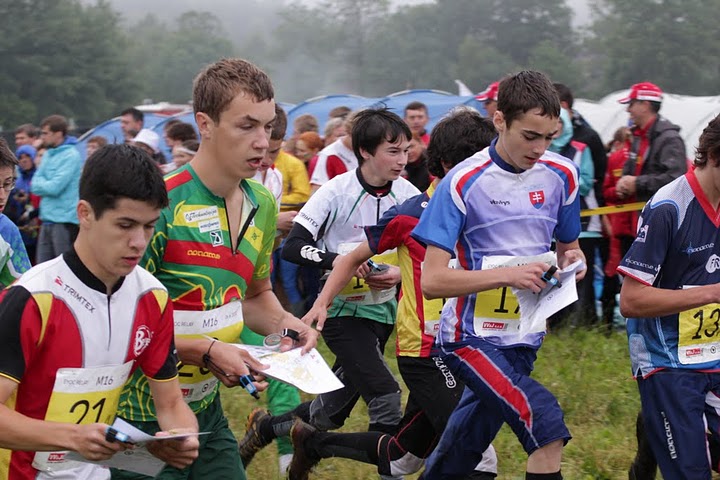
A team of M16's (Harry Millar and Jonathan Quinn - pictured in the Relay start),  M18's (Eoin McCullough, Laurence Quinn and Mark Stephens) and W16's (Clíona McCullough and Niamh Corbett) ran in the European Youth Championships in the Czech Republic at the end of June. The team was led by Greg McCann and Brenda Hynes and the results can be found here.

The team had mixed fortunes, but EYOC is great experience as preparation for big international competition.

Shamrock O-Ringen
Rather belatedly, a brief report on another memorable Shamrock O-Ringen in West Cork on the June Bank Holiday weekend.  Yet again the visitors almost outnumbered the Irish competitors, for whatever reason. Are we scared of the contours? The marshes? The midges? Are we afraid that we'll get terminally lost? Even if we did, to be running around a West Cork marsh with the cuckoos, the myrtle and the fantastic terrain is a wonderful way to spend a weekend.
Word of the Shamrock is leaking out, though - people from all around Europe come back again and again to savour the atmosphere and terrain. One runner put it in the same category as Finland's Jukola overnight relay - it's simply a unique event.
Kilcrohane provided the focus, with a middle distance race on Saturday, a classic distance on Sunday and a chasing start on Monday (where the winner is the first to cross the line). Darren Burke took the M21 Elite title, only seconds ahead of ken Peeters (Belgium) - see the photo. Cath Chalmers from Australia won the W21 Elite race. Overall results are here.
Next year's Three Day is in the Oughterard area of Co. Galway, run by WEGO, on the first weekend in June.

WMOC
A number of Irish competitors are at the World Masters Orienteering Championships at Pecs in Hungary. The forested karst limestone terrain is different to anything we have here, so it will be a new challenge. Read about the events here.
The lady on the left is Sarolta Monspart, 1972 World Champion from Hungary. She was the first non-Scandinavian World O-Champion, seen here at the opening ceremony for WMOC 2011.


Setanta Rogaine
Boggy underfoot conditions and very warm weather did not deter the competitors at the 2011 Setanta Orienteers Rogaine on June 25th/26th in Co. Wicklow.  The championship event, 24 Hour Team, was won by Nicholas Mulder & Ryno Griesel (Rand OC, South Africa) who managed to collect all controls within the 24 hours. This is a great achievement in the bog and heather of Wicklow, something the pair wouldn't be used to. The conditions were very wet under foot after a lot of rain the day and the night before the event. They may have been more used to the heat wave that we suddenly got over the weekend though, with temperatures of 23C during the day. It was a warm, clear, calm night for those who spent the night out on the hills. The 6 Hour Team event was won by Ruth Lynam & Don Short (CNOC). This was a great win for them in their first 6 hour Rogaine after competiting in many previous 24 hour Rogaines. Paul Mahon took the honours in the new addition to the Rogaine events, the 6 Hour Individual


Jukola Relay
There was a small Irish presence at the Jukola 7-person overnight relay in Finland on June 18/19. A CNOC team of Conor and Ruairi Short, Shea, Kevin and Niamh O'Boyle, Hugh Cashell and Colm Hill finished in a highly respectable 296th (not 765th as I said earlier!) place among the 1500 teams to start. Bishopstown's Nick Simonin, running for his Stockholm club Lidingo IFK, came in an amazing 23rd place on leg 1 (which started at 10.55 pm), only about 90 seconds down on the leaders. John and Eoin McCullough and Ronan Cleary ran on a London OK team and Nina Heikkinen (Philips) and Julie Cleary ran in the Venla 4-person Women's relay earlier in the day.
The Jukola is an amazing event: about 15,000 runners between the two races. There are orienteers in Finland whose only event of the year is the Jukola.
Next year's race is only 10 km from Helsinki Airport ...

Here, Eoin McCullough reports on his first Jukola relay:
My first experience of the Jukola relay in Finland is one I will never forget. Myself, my dad and two friends arrived in a muddy car parking field with a hint of rain in the air on Saturday afternoon. We found our army tent, which would be our accommodation for the night, and then went to check out the arena. For those of you who haven't been to Jukola before, the arena is like a small town, with everything you could possibly need at an orienteering event, or anywhere else, for that matter.
After an hour or so, we began to move towards the start of the Venla relay, the womens' relay. At 10 minutes past 2, over 1400 women streamed up the hill from the start and into the forest. The Venla relay turned out to be closely fought by Domnarvets GoIF of Sweden and Tampereen Pyrinto of Finland, with the Finnish team missing the second last control, where Domnarvets passed them and won the Venla by only 35 seconds.
A few hours later as darkness was beginning to descend, the slope above the starting pen became crowded with people, eagerly awaiting the start of the Jukola. As it got closer and closer to the start time, there was an electricity in the air as the runners turned on their headlights, a mass of lights bobbing up and down in the Finnish countryside. Then, at 10:55, an artillery gun signalled the start of the greatest relay in the world. Suddenly, the bobbing headlights were streaming out of the start and up the hill, with an Irishman getting to the top first, Nick Simonin.
After the start, everyone began to move to the finish arena where there was a huge screen with live images from the forest with live splits. It was thrilling to see 1500 headlights worming their way through the forest. The atmosphere in the arena was great, with everyone there looking out for their team to come through the next radio control. I went to bed after only 30 minutes of the mens' race, because I still had to run the next morning on leg 6 for my team.
As I was asleep, Halden SK won the Jukola by over 4 minutes to make it two Jukola wins in two years. Meanwhile, there was fierce competition for second place with Kalevan Rasti getting the better of Delta and Vaajakosken Tera for second place, with Delta finishing in third.
When I woke up to prepare for my race, the leading teams had long finished. I was in a mass start with over 1000 others. I myself had a good run and really enjoyed the runnable, technical forest and was in the top third of runners on my leg. I really enjoyed the run and was very happy it.
After my run we did some shopping, ate, and enjoyed the sun that had been shining since the early morning, making lovely running conditions, drying the ground and making it feel like summer again.
Later that day, most of my team stayed with friends who lived an hour away, near the Russian border. There we had a sauna, a swim in the lake, a good meal, and a well-deserved night's sleep in beds.
The next day we flew back from Helsinki to Dublin, ending an unforgettable few days. I really enjoyed everything about the Jukola, the running, the spectating, and especially, the incredible atmosphere of the Jukola. It was a great experience for me and all I want to do is do it all again next year.....
Scottish 6-Day Good luck to everyone going to the Scottish 6-Day at Oban at the end of July. This is a real taste of big-time international multi-day orienteering, with more than 3000 runners from all around the world. Entries are still open, by the way: see here. World Championships Of course the big event this summer is the World Orienteering Championships near Chambéry in France in mid-August. Will Thierry Gueorgiou be disqualified or fail to finish again? The Irish team have been preparing in France and Scandinavia and are ready to go: read their blog here. The Junior Squad are taking in the associated "O-Festival ERDF" as their summer tour. Details of this event, with more than 3000 runners, are here.
Meet the Irish Team, David Healy, Marcus Pinker, Seamus O'Boyle, Darren Burke, Nick Simonin, Ruairí Short, Niamh O'Boyle, Aislinn Austin, Ros Hussey and team leader Kyle Herron,  here


Finally, have a great summer of orienteering - and please write about it for TIO when you're there or when you come home!
John McC .
PS Here are some more photos from EYOC and JWOC.
Josh O'Sullivan-Hourihan, JWOC Sprint
Conor Short, JWOC Sprint
Jack Millar, JWOC Sprint
Clíona McCullough, EYOC Sprint
Eoin McCullough, EYOC Sprint
Harry Millar, EYOC Long
Jonny Quinn, EYOC Long
Laurence Quinn, EYOC Long
Mark Stephens, EYOC Sprint
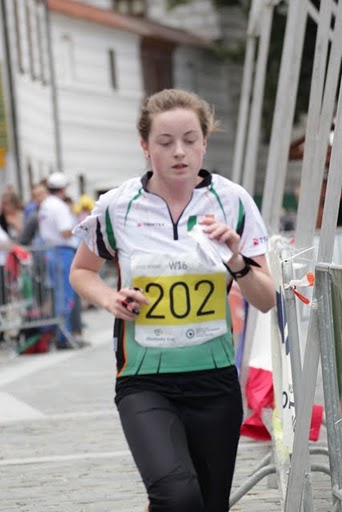
Niamh Corbett, EYOC Sprint